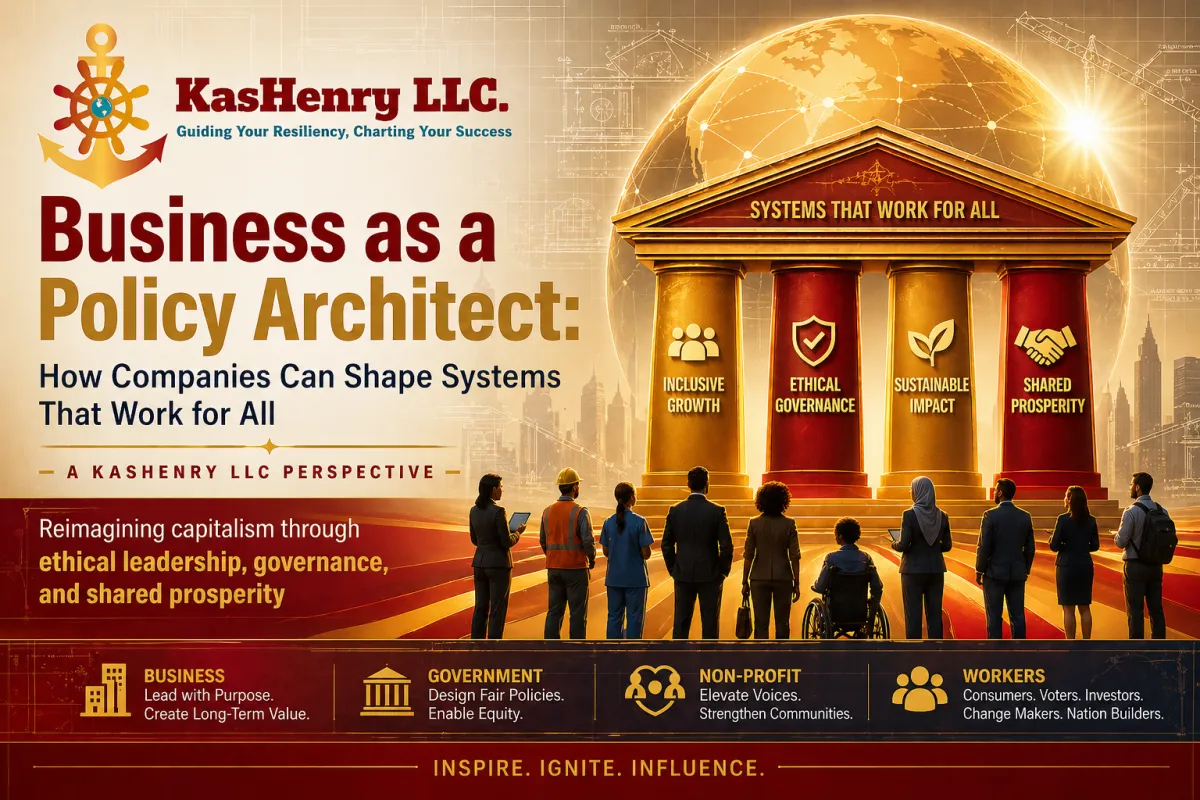
Business as a Policy Architect: How Companies Can Shape Systems That Work for All
In a world marked by volatility, inequality, and rapid technological disruption, the question is no longer whether businesses should engage in public policy. It is how they do so responsibly, transparently, and with integrity.
At KasHenry LLC, the philosophy of “Building to Last and Ennobling for Success” calls organizations to rise beyond profit optimization toward system stewardship, where business becomes a co-architect of policies that enable human flourishing, economic resilience, and societal trust.
This is not activism.
This is leadership.
From Market Participant to System Architect
Historically, businesses have operated within policy frameworks designed by governments. Today, the most forward-thinking organizations recognize a deeper truth:
Markets do not exist in isolation. They are designed ecosystems shaped by policy, behavior, and values.
When businesses engage in policy formation, they are not just influencing regulation, they are shaping the rules of the game that determine:
Who participates
Who benefits
Who is left behind
This is where ethical leadership becomes the differentiator.
As highlighted in KasHenry LLC thought leadership, legislation alone cannot correct systemic failures; it is the character and values of leadership that determine outcomes.
The Governance Imperative: Designing with Integrity
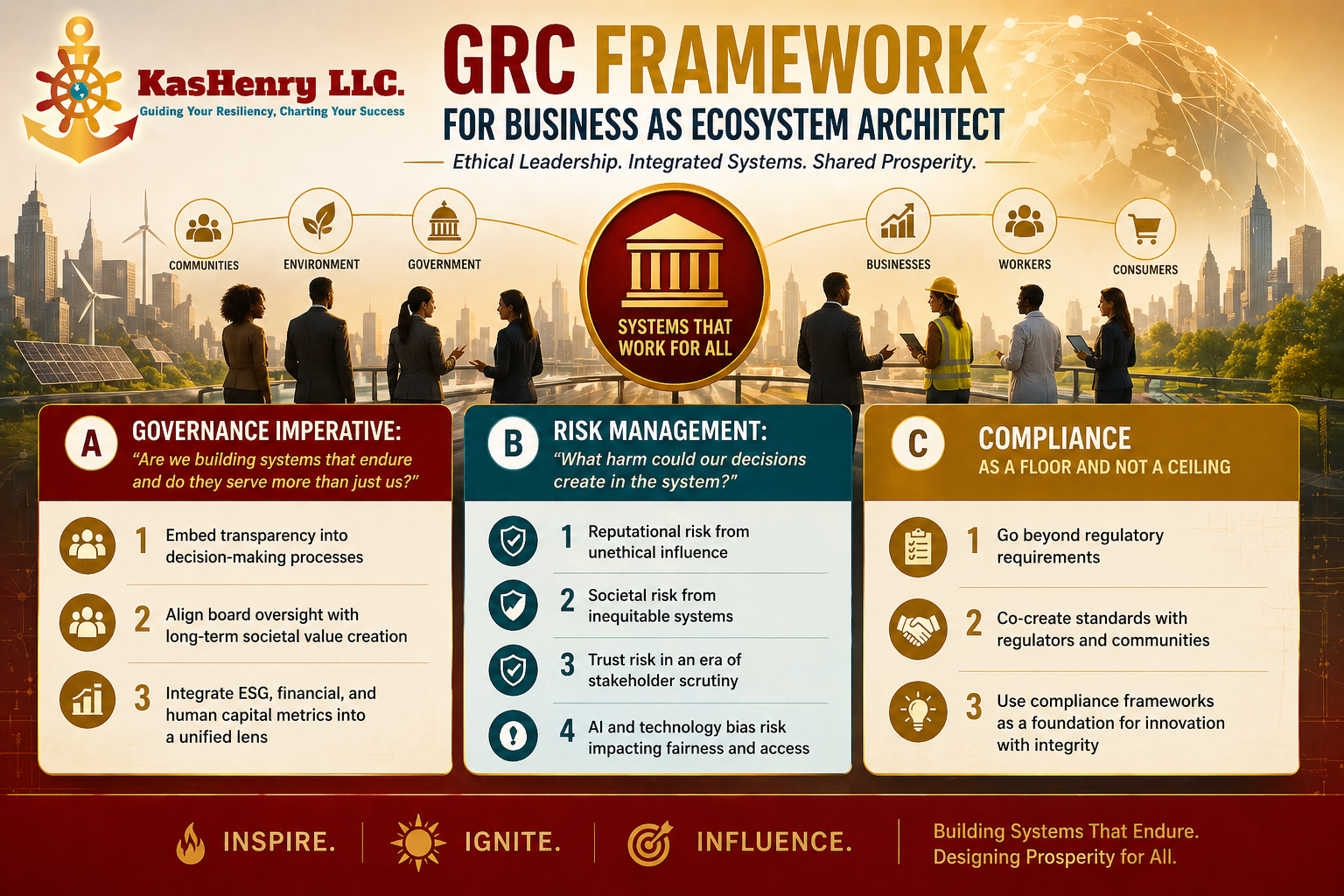
Governance is no longer a compliance checkbox, it is a strategic design function.
Ethical governance requires organizations to:
Embed transparency into decision-making processes
Align board oversight with long-term societal value creation
Integrate ESG, financial, and human capital metrics into a unified lens
At its highest level, governance asks:
“Are we building systems that endure and do they serve more than just us?”
Risk Management: Expanding the Definition of Risk
Traditional risk management focuses on financial, operational, and regulatory exposure.
Today’s leaders must expand that definition to include:
Reputational risk from unethical influence
Societal risk from inequitable systems
Trust risk in an era of stakeholder scrutiny
AI and technology bias risk impacting fairness and access
Ethical leadership reframes risk from:
“What could hurt the company?”
to
“What harm could our decisions create in the system?”
This shift transforms risk management into a proactive force for good, not just self-protection.
Compliance as a Floor—Not a Ceiling
Compliance ensures adherence to laws.
But laws, by nature, lag innovation and moral evolution.
Our philosophy emphasizes that:
Compliance is the minimum standard
Ethical leadership is the aspirational standard
Organizations that lead in policy architecture:
Go beyond regulatory requirements
Co-create standards with regulators and communities
Use compliance frameworks as a foundation for innovation with integrity
Inclusive Capitalism: Policy as a Lever for Shared Prosperity
The future of capitalism is not a trade-off between profit and purpose. It is the integration of both.
Through inclusive capitalism frameworks championed in our work:
Businesses drive economic growth
While expanding access, equity, and opportunity
Policy engagement becomes a tool to:
Democratize access to capital and technology
Strengthen workforce resilience
Enable small businesses and underserved communities
Create ecosystems where prosperity is shared—not concentrated
This is how businesses move from value extraction to value creation.
The Human Element: Workers as System Stakeholders
One of the most overlooked truths in policy design:
Workers are not just employees. They are consumers, voters, and investors.
They operate across all three pillars of society:
Market (as employees and consumers)
State (as voters and civic participants)
Civil society (as community members and change agents)
KasHenry LLC’s framework of a functional society highlights that these roles are interconnected and policy must reflect this reality.
What does this mean for organizations?
Employees must be educated and empowered to understand policy impacts
Organizations must foster psychological safety so voices are heard
Workforce engagement becomes a strategic advantage in policy shaping
When workers are engaged:
Policies become more grounded
Businesses become more trusted
Systems become more resilient
Cross-Sector Collaboration: The New Leadership Frontier
No single institution can solve systemic challenges alone.
Dr. Kasthuri Henry’s work emphasizes the importance of public-private-nonprofit partnerships to drive meaningful transformation.
The future belongs to leaders who can:
Convene across sectors
Translate between business, government, and community priorities
Build coalitions rooted in trust and shared outcomes
Policy architecture is no longer about influence—it is about co-creation.
A Framework for Responsible Policy Engagement
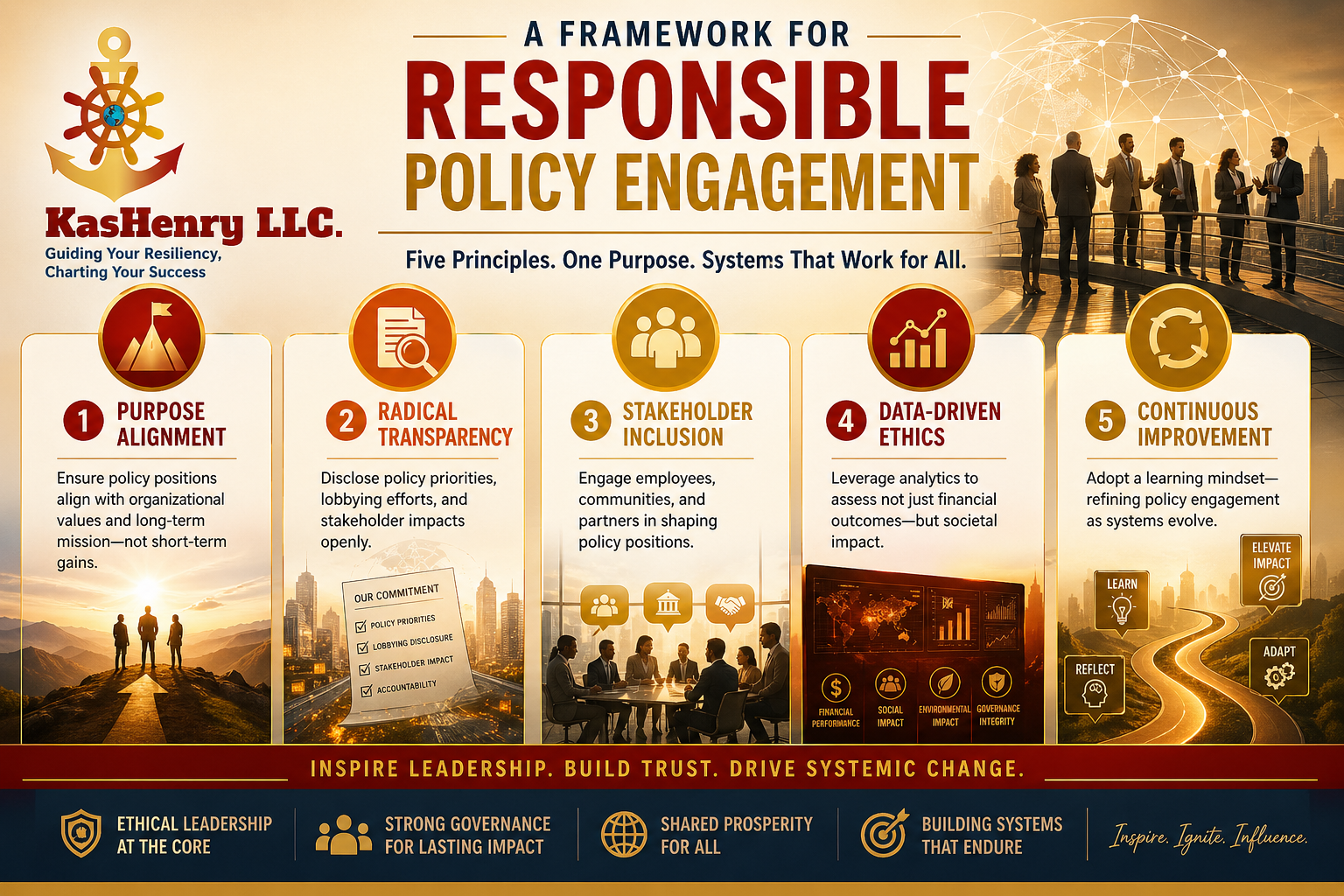
To operationalize this vision, organizations must anchor their approach in five principles:
1. Purpose Alignment: Ensure policy positions align with organizational values and long-term mission—not short-term gains.
2. Radical Transparency: Disclose policy priorities, lobbying efforts, and stakeholder impacts openly.
3. Stakeholder Inclusion: Engage employees, communities, and partners in shaping policy positions.
4. Data-Driven Ethics: Leverage analytics to assess not just financial outcomes—but societal impact.
5. Continuous Improvement: Adopt a learning mindset—refining policy engagement as systems evolve.
The Call to Action: Leading the Systems We Inhabit
This is a defining moment.
Business leaders, policymakers, and nonprofit innovators must ask:
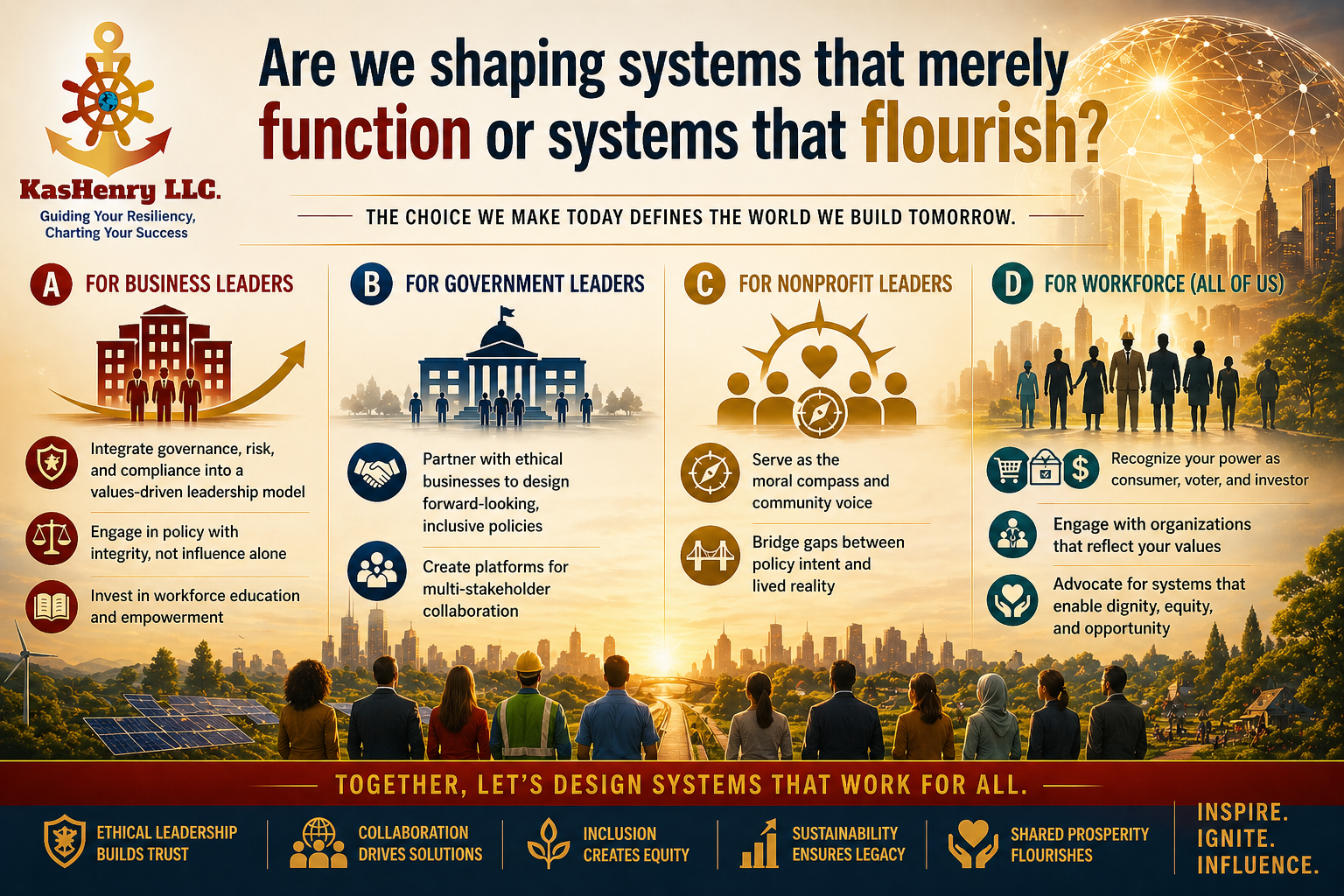
Are we shaping systems that merely function or systems that flourish?
For Business Leaders
Integrate governance, risk, and compliance into a values-driven leadership model
Engage in policy with integrity, not influence alone
Invest in workforce education and empowerment
For Government Leaders
Partner with ethical businesses to design forward-looking, inclusive policies
Create platforms for multi-stakeholder collaboration
For Nonprofit Leaders
Serve as the moral compass and community voice
Bridge gaps between policy intent and lived reality
For Workforce (All of Us)
Recognize your power as consumer, voter, and investor
Engage with organizations that reflect your values
Advocate for systems that enable dignity, equity, and opportunity
Closing Reflection: The Legacy We Choose
At its core, business is not just an economic engine. It is a social institution with the power to shape human outcomes.
The question is not whether that power will be used.
The question is:
Will it be used to ennoble or to extract?
At KasHenry LLC, the answer is clear:
Inspire. Ignite. Influence.
Because the systems we design today will define the societies we inherit tomorrow.


